
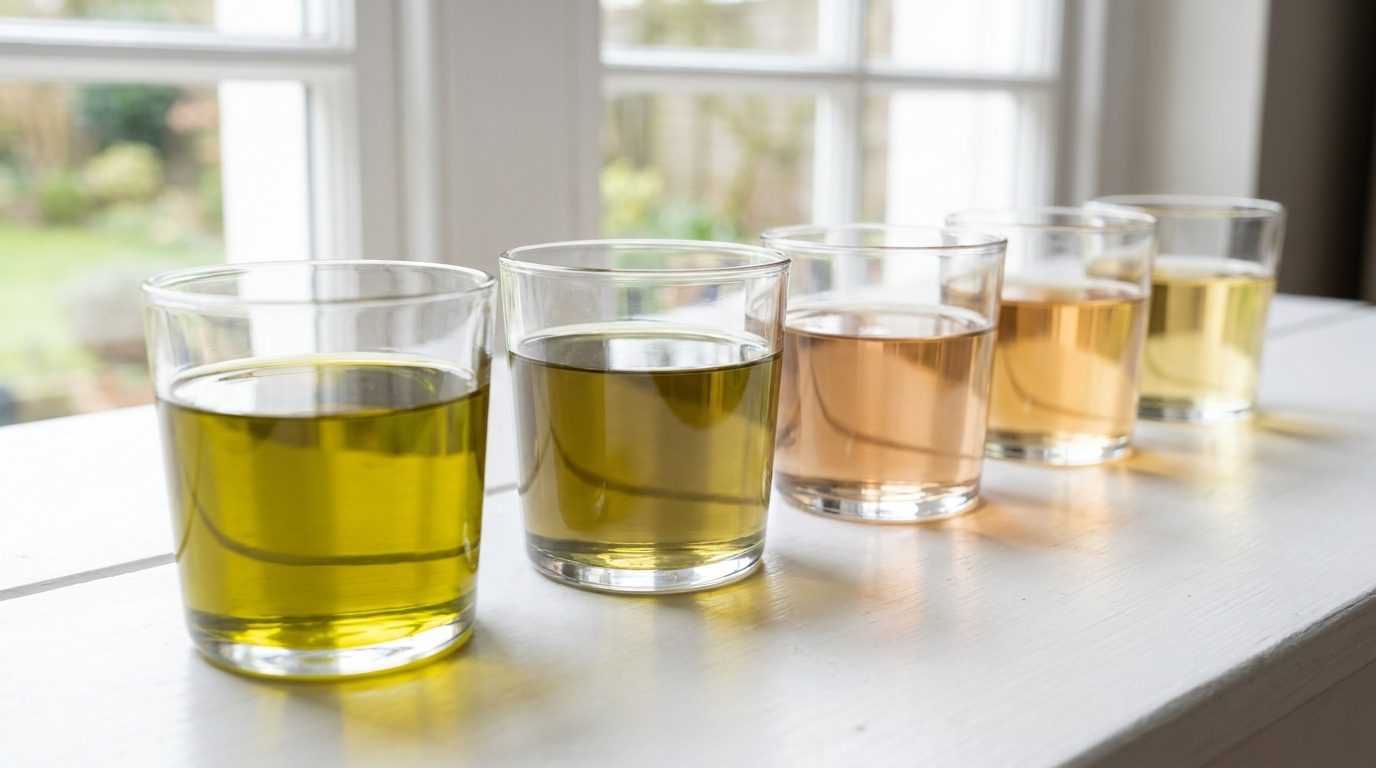
Refined hemp oil and virgin hemp oil come from the same seed, and frequently from the same press. Everything that separates them happens afterward, in a sequence of steps borrowed from the wider edible oil industry — and each step is designed to remove one specific class of compound.
What actually comes out of the press?
Crude hemp seed oil is far more than triglycerides. Coming off an expeller or out of a solvent extractor, it carries phospholipids (the "gums"), free fatty acids liberated by enzymes in the seed before and during pressing, chlorophyll and carotenoid pigments, plant waxes, tocopherols, sterols, traces of iron and copper picked up from soil and equipment, a little moisture, and fine particles of seed meal.
Virgin hemp oil is that crude oil settled, filtered and bottled. Refining is the decision to strip most of the non-triglyceride fraction out. Those minor components are precisely what give virgin oil its dark green colour and grassy flavour — and also what make it short-lived and heat-sensitive. Removing them is a trade, not a straightforward upgrade.
Degumming and neutralizing
Degumming comes first. Water, or water with a small dose of food-grade acid, is mixed into the warm oil so that phospholipids hydrate, become insoluble in the oil phase, and can be separated by centrifuge. Gums matter for three reasons: they foam, they carry trace metals that catalyse oxidation, and they scorch and darken when the oil is later heated.
Neutralizing — also called caustic or alkali refining — follows. A measured dose of dilute alkali converts free fatty acids into soaps, which leave with the aqueous phase and are washed out. Free fatty acids are the main reason a crude oil smokes at a low temperature, so this step alone lifts the smoke point noticeably. Some processors skip caustic treatment entirely and use physical refining instead, stripping the free fatty acids later under vacuum in the deodorizer.
Bleaching: where the green colour goes
"Bleaching" is a misleading name, because no bleach is involved. The oil is agitated under vacuum with an adsorbent — usually an activated clay or bleaching earth, sometimes with a small addition of activated carbon — and then filtered. The adsorbent holds onto chlorophyll, carotenoids, residual soaps, trace metals and, importantly, peroxides and breakdown products left behind by any oxidation that has already taken place.
Chlorophyll is the compound most buyers notice, since it is the reason virgin hemp oil is green. It is also a photosensitizer: in the presence of light and oxygen it drives a rapid oxidation reaction. Pulling the pigment out is the single biggest reason refined hemp oil tolerates a clear bottle on a lit shelf far better than virgin oil does.
Winterizing: the optional cold soak
Not every hemp oil is winterized, but many bulk lots are. The oil is chilled slowly, held cold until the higher-melting waxes and saturated glycerides crystallize out, then filtered while still cold. The result stays bright and clear in a cool warehouse or a refrigerator instead of throwing a haze.
Winterization is cosmetic in the sense that a cloudy oil is not a spoiled oil. It matters commercially because buyers reject cloudy product on sight, and it matters technically for cosmetic formulators who need a clear serum, or an emulsion that will not develop visible specks in a cold shipping container.
Deodorizing: the step that does the most
Deodorization is steam distillation under deep vacuum at high temperature. Live steam is sparged through the hot oil, and the volatile compounds — aldehydes, ketones, remaining free fatty acids, and the odour and flavour molecules that define virgin hemp oil — leave with the steam and are condensed off. What comes out the other end is a bland, pale oil with very little smell.
This step defines the product, and it is also where most of the collateral damage occurs. Tocopherols distil off alongside the odour compounds, and if temperature or residence time is pushed too hard, some of the polyunsaturated fatty acids isomerize. Careful refiners run the deodorizer as cool and as briefly as the target specification allows, precisely because hemp oil is unusually rich in fragile fatty acids.
What refining costs, and what it buys
Every step loses oil. Gums, soapstock, spent clay and deodorizer distillate all carry product away, so a refined litre represents more seed than a virgin litre does. Antioxidant capacity drops too, since a good share of the natural tocopherols end up in the distillate; some refiners add tocopherols back or blend in rosemary extract to compensate.
What you buy in return is a neutral oil with a higher smoke point, a longer practical shelf life, a consistent pale colour with no green cast, and a flavour and scent that disappear into a formula rather than dominating it. That is why refined oil dominates soap kettles, cosmetic labs and industrial applications while virgin oil holds the salad-dressing and finishing-oil market. Neither is better in the abstract — they answer different questions, a theme that runs through most of our hemp oil articles.
If you are evaluating a supplier, ask which refining route they run — full caustic refining or physical refining — and ask for free fatty acid, peroxide value and colour figures on your actual lot rather than on a generic data sheet. Those three numbers together tell you whether the refining was done properly and whether the oil has been sitting in a warehouse since.