
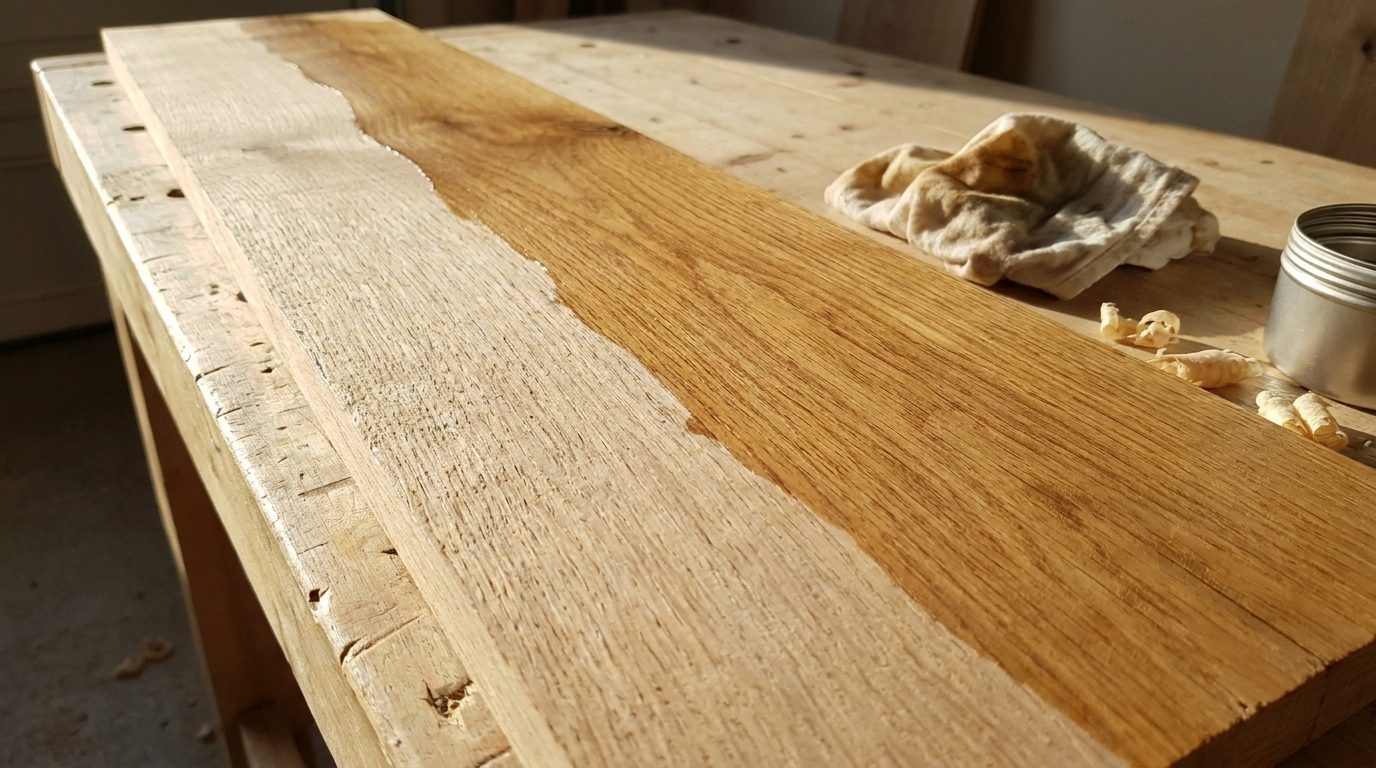
Long before hemp seed oil was a food, oils like it were coatings. Hemp cures by the same oxidative mechanism as linseed — just more slowly, and to a softer film — and understanding why tells you exactly where it belongs in a finishing schedule.
What makes an oil a "drying" oil?
Drying oils do not dry. Nothing evaporates. What happens is autoxidation: oxygen attacks the carbon atoms sitting between two double bonds, forming radicals that crosslink neighbouring triglyceride molecules into a continuous three-dimensional network. The film actually gains weight as it cures, and it keeps changing for weeks after it stops feeling tacky.
The speed of that reaction depends on how many of those reactive positions the oil contains. Iodine value, which measures total unsaturation, is the rough index the trade uses. By convention, oils above roughly 150 are called drying, those in the 120 to 150 band semi-drying, and those below non-drying. Hemp seed oil typically lands in the 140 to 170 range, straddling the boundary — genuinely capable of curing, but not in the same class as linseed.
Where hemp sits between linseed and sunflower
Iodine value alone understates the difference. What drives fast curing is specifically the triple-unsaturated alpha-linolenic acid, which contains two of those highly reactive positions per molecule instead of one. Linseed oil is roughly half linolenic acid. Hemp oil is mostly linoleic, with linolenic in the mid-teens to around twenty percent.
The practical consequences are consistent and predictable:
- Hemp cures considerably more slowly than linseed under the same conditions, particularly in cool or humid air.
- The cured film is softer and more flexible, which is an advantage on wood that moves and a disadvantage on a floor.
- It yellows less over time than linseed, because yellowing tracks linolenic content — a real benefit on pale woods and light-tinted paint.
- It penetrates well and builds slowly, so it behaves like a penetrating oil rather than a film-former unless it is bodied or blended.
Does refining change how it cures?
Yes, in ways that mostly favour the finisher. Refining removes chlorophyll, so a refined oil will not push a green cast into maple, ash or a white pigment. It removes gums and mucilage that can cause a finish to stay gummy or to feed mould in humid conditions. It removes free fatty acids that contribute to odour and to poor water resistance. And it produces consistent colour from lot to lot, which matters if you are matching a finish months apart.
There is one trap worth knowing. Antioxidants exist to stop autoxidation, which is exactly the reaction you want in a coating. A food-grade refined hemp oil sold with added tocopherols or rosemary extract will cure more slowly than the same oil without them. If you are buying oil for finish work, ask specifically whether antioxidants have been added and request an oil without them.
Driers, bodying and blends
Raw hemp oil on its own is slow. The coatings trade solves this with metal driers — organometallic soaps that catalyse the oxidation reaction. Cobalt has traditionally been the surface drier, with zirconium, manganese, calcium and other metals used as through-driers and auxiliaries; regulatory pressure on cobalt has pushed formulators toward alternative iron and manganese complexes. Driers are used at very low levels and overdosing produces a skinned surface over an uncured interior.
Heat bodying is the other lever. Cooking the oil under controlled conditions partially polymerizes it in advance, producing a thicker stand-oil-like material that levels beautifully, builds faster and yellows less. Hemp oil is also commonly blended rather than used neat — with linseed for speed, with tung for water resistance and hardness, and with solvent for penetration on the first coat. Alkyd chemistry takes this further, reacting hemp fatty acids with polyols and dibasic acids into a resin that cures far faster than the parent oil.
Practical limits and one real hazard
Set expectations honestly. A hemp oil finish is a penetrating, repairable, low-sheen finish. It will not match a catalysed varnish for abrasion or chemical resistance, it stays slightly softer than a linseed film, and full cure takes weeks even when the surface feels dry in a day or two. Thin coats, wiped back hard, cure far better than thick ones — a heavy coat skins over and stays soft underneath indefinitely.
The hazard is not the finish, it is the rags. Autoxidation is exothermic. Oil-soaked rags left crumpled in a bin generate heat faster than they can shed it and can ignite without any external flame. Spread used rags flat outdoors to cure completely, or submerge them in water in a sealed metal container. This applies to hemp oil exactly as it applies to linseed, and it is the one thing in this article that can burn a shop down.
Specifying oil for finishing work
When you order, ask for the iodine value, the colour, the peroxide value and free fatty acid content, and confirmation that no antioxidants have been added. A high peroxide value on arrival means the oil has already begun oxidizing in the drum, which affects both cure behaviour and colour. Store the oil cool and dark and keep containers full, because the same reactivity that makes it cure in a film makes it thicken in a half-empty pail.
If you are trialling hemp oil against a finish you already use, run identical samples on offcuts of the actual species, in the actual shop conditions, and leave them a full month before judging hardness. Our other refined hemp oil articles cover the specification side in more depth, but for coatings work the sample board tells you more than the data sheet.