
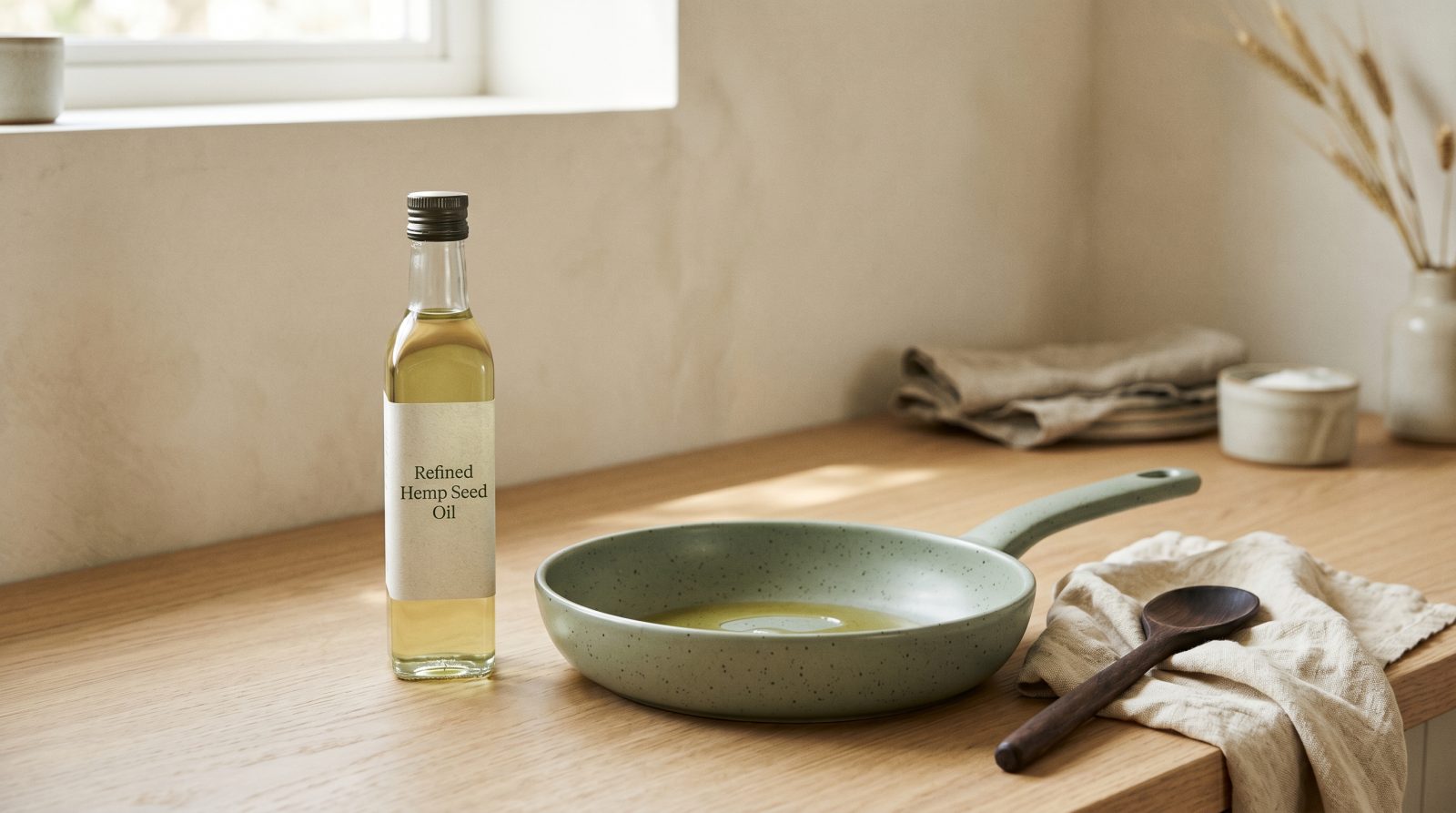
Refined hemp oil tolerates more heat than cold-pressed hemp oil: refining strips out the free fatty acids and other minor compounds that make the virgin oil smoke at about 165 degrees Celsius, and supplier figures for the refined oil run from roughly 200 to 230 degrees. What refining leaves essentially unchanged is the fat itself. Refined hemp oil is still about 80 percent polyunsaturated, more than sunflower or corn oil, and polyunsaturated fats break down fastest under heat. That makes it a good oil for baking and gentle cooking, and a poor one for frying, searing and high-heat roasting.
What refined hemp oil is good for
Baking
Its neutral flavour suits cakes, muffins, quick breads and other baked goods. Mixed into a batter, the oil stays well below the oven temperature for most of the bake, which makes baking one of its best uses.
Gentle sautéing and warming
Softening onions, garlic or vegetables over low to medium heat, warming cooked grains or adding the oil near the end of cooking all keep it cooler than frying. Keep the heat moderate and the cooking brief, and stop well short of the oil shimmering or smoking.
Neutral dressings, dips and mayonnaise
Where you want hemp oil's fats without its grassy flavour, refined hemp oil works cold in dressings and dips. For flavour, cold-pressed oil is the better choice.
What to use a different oil for
Searing, stir-frying, roasting at high oven temperatures and any frying, shallow or deep, hold oil at around 180 degrees or hotter, often for many minutes. There, the oil's fat make-up matters more than its smoke point. In a laboratory simulation of shallow frying, with oils held at 180 degrees for up to 90 minutes, the toxic aldehydes an oil produced rose with its polyunsaturated fat content, and canola and extra virgin olive oil produced less than polyunsaturated sunflower and corn oil (Moumtaz and colleagues, Scientific Reports, 2019). Hemp oil, which was not tested, is more polyunsaturated than any of them. For these jobs, use an oil lower in polyunsaturated fat, such as high-oleic sunflower, canola, avocado or refined olive oil.
How refined hemp oil compares
| Oil | Smoke point (approx.) | Polyunsaturated fat (share of total) | Best kitchen use |
|---|---|---|---|
| Cold-pressed hemp oil | ~165°C | ~77–84% | Raw, finishing |
| Refined hemp oil | ~200–230°C (supplier figures) | ~77–84% | Baking, gentle cooking |
| Sunflower oil (regular, refined) | ~232°C | ~66% | Moderate heat |
| Refined peanut oil | ~232°C | ~32% | Frying, stir-frying |
| Refined canola oil | ~240°C | ~28% | Most cooking, frying |
| Extra virgin olive oil | ~191°C | ~10% | Low to medium heat |
Smoke points are typical published values and vary by product; the refined hemp figure comes from suppliers and has not, as far as we could find, been independently measured. Polyunsaturated shares are from USDA FoodData Central and, for hemp, a published analysis of hempseed oils. High-oleic sunflower and avocado oil are also low in polyunsaturated fat (about 4 and 14 percent).
Refined hemp oil versus canola
The two look alike on the shelf, but canola is mostly monounsaturated fat, with about 28 percent polyunsaturated against roughly 80 percent for hemp, which is why canola handles frying better. Hemp's advantages are nutritional rather than culinary: it contains GLA, which canola does not, and more omega-3 per tablespoon. Canola actually has the lower omega-6 to omega-3 ratio, about 2 to 1 against hemp's 2.5 to 3. Refined hemp oil also costs considerably more per litre.
Practical kitchen organisation
A sensible pattern is to keep three oils:
- Cold-pressed virgin hemp oil in a small dark glass bottle, refrigerated. For dressings, finishing and skincare.
- Refined hemp oil, stored cool and dark, for baking and gentle cooking.
- A heat-stable oil, such as canola, high-oleic sunflower, avocado or refined olive oil, for frying, searing and high-heat roasting.
That way each oil does the job it handles best.