
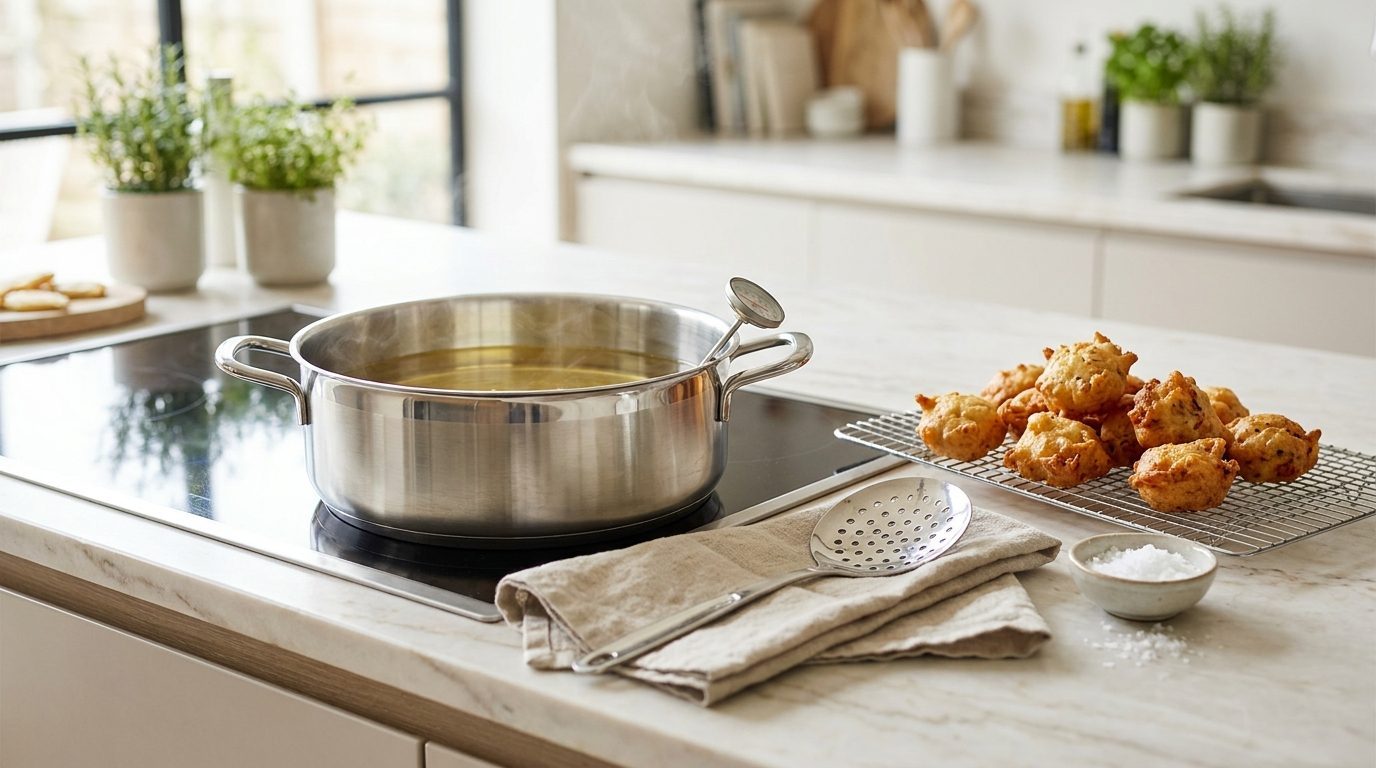
The short answer is no — you should not deep fry with refined hemp oil. Its heavily polyunsaturated fat breaks down quickly under frying heat, and its smoke point, which supplier figures put at roughly 200 to 230 degrees Celsius, may leave little headroom above typical deep-frying temperatures. It is a good oil for baking and gentle cooking, but frying of any kind is a job for a more heat-stable oil.
Why refined hemp oil falls short for deep frying
Deep frying is one of the most demanding things you can ask of a cooking oil. Food is submerged in oil held at a steady 175 to 190 degrees Celsius, and that oil is often kept hot for long stretches and reused across multiple batches. Two characteristics of refined hemp oil make it a weak choice for this job:
- Its smoke point gives little margin. Supplier figures run from about 200 to 230 degrees Celsius. At the low end that leaves little headroom above the 175 to 190 degree frying window, and even at the high end the smoke point does not offset the oil's polyunsaturated fat. Each reuse also lowers the smoke point further.
- It is highly polyunsaturated. Hemp seed oil is rich in polyunsaturated fatty acids (the omega-6 linoleic acid and omega-3 alpha-linolenic acid that make it nutritionally interesting in the first place). Those same double bonds are chemically fragile. Under prolonged heat and exposure to oxygen, polyunsaturated oils oxidize and degrade faster than oils dominated by monounsaturated or saturated fats.
In other words, the very thing that makes hemp oil appealing on a salad — its delicate, omega-rich fatty acid profile — is what makes it a poor candidate for the deep fryer.
What actually happens to the oil at frying temperatures
When any oil is held near or beyond its smoke point, it begins to break down through several overlapping processes. Understanding them explains why a near-the-limit polyunsaturated oil ages so badly in a fryer:
- Oxidation. Oxygen attacks the unsaturated bonds in the fat, producing peroxides and, eventually, a cascade of secondary breakdown compounds. More double bonds means more vulnerable sites, which is exactly why polyunsaturated oils oxidize faster than monounsaturated ones.
- Polymerization. Degraded oil molecules link together, thickening the oil, darkening it, and leaving the sticky, varnish-like residue that coats a neglected fryer. Hemp oil is naturally somewhat drying — it slowly polymerizes the way linseed oil does — which is a useful trait in a wood finish and an unhelpful one in a fryer.
- Smoke and free fatty acid formation. Once the oil passes its smoke point it sheds acrid, bluish smoke and the smoke point itself starts dropping with each cycle, so each subsequent batch fries worse than the last.
The practical upshot: even if you managed a single careful batch, refined hemp oil would not hold up to the reuse that makes deep frying economical, and you would be discarding expensive oil after minimal use.
Is shallow frying or pan-searing different?
Less than you might think. Shallow frying, pan-searing and stir-frying are shorter and use less oil, but they run at similar or higher temperatures, and a thin layer of oil in a hot pan is exposed to plenty of air. In a laboratory simulation of shallow frying, with oils held at 180 degrees for up to 90 minutes, polyunsaturated sunflower and corn oil produced more toxic aldehydes than canola and extra virgin olive oil (Moumtaz and colleagues, Scientific Reports, 2019). Hemp oil, which was not tested, is more polyunsaturated than any of them.
So the line is not just duration and reuse. Use a heat-stable oil for searing, shallow frying and stir-frying too, and keep refined hemp oil for gentler work.
Better oils for deep frying
For genuine deep frying you want an oil with a high smoke point and a more heat-stable fatty acid profile — typically one with more monounsaturated or saturated fat and fewer fragile polyunsaturated bonds. Refined oils generally have higher smoke points than their unrefined counterparts because refining removes the free fatty acids and impurities that lower the smoke point. Common choices and their approximate smoke points:
| Oil | Approx. smoke point | Suitability for deep frying |
|---|---|---|
| Refined hemp oil | ~200–230°C (supplier figures) | Poor — about 80% polyunsaturated, little headroom |
| Refined peanut oil | ~232°C | Good — a classic frying oil |
| Refined avocado oil | High; varies by product | Good — mostly monounsaturated |
| Refined sunflower (high-oleic) | High; varies by product | Good — heat-stable high-oleic versions |
| Refined canola oil | ~240°C | Good — economical all-purpose fryer oil |
High-oleic versions of sunflower and safflower oil are worth singling out: breeding for higher monounsaturated (oleic) content gives them far better resistance to oxidation than ordinary high-polyunsaturated versions, and refining gives them a high smoke point. For repeated frying, that stability matters as much as the raw smoke point number.
Where refined hemp oil genuinely shines instead
Steering away from frying does not mean refined hemp oil lacks a place in the kitchen — it simply belongs to a different set of jobs. Its near-neutral flavour and pale colour make it well suited to:
- Baking cakes, muffins, and quick breads, where its neutrality keeps it from intruding on flavour and the batter keeps it well below oven temperature.
- Gentle sautéing, softening onions, garlic and vegetables over low to medium heat without letting the pan smoke.
- Neutral dressings, dips and mayonnaise, where you want hemp oil's fats without its grassy flavour.
It also has a more favourable omega-6 to omega-3 ratio than sunflower or corn oil, which is a reason to use it where heat is gentle rather than to cook it hard. If you want to dig further into where it sits among other cooking fats, the article index covers smoke point science and oil comparisons in more depth.
How to choose, in practice
Keep the decision simple. If you are reaching for a pot of oil to submerge food for several minutes, or you intend to strain and reuse the oil, refined hemp oil is the wrong choice — pick refined peanut, refined avocado, or a high-oleic sunflower or canola oil and keep your target temperature comfortably below their smoke points. Reserve your refined hemp oil for baking and gentle cooking, where its polyunsaturated fat is not pushed hard and its nutritional profile is an asset. And whatever oil you fry in, watch for the signals that it has had enough: persistent smoking below normal temperature, a darkening colour, a thick or foamy texture, and a stale, rancid smell all mean it is time to discard it rather than push one more batch.