
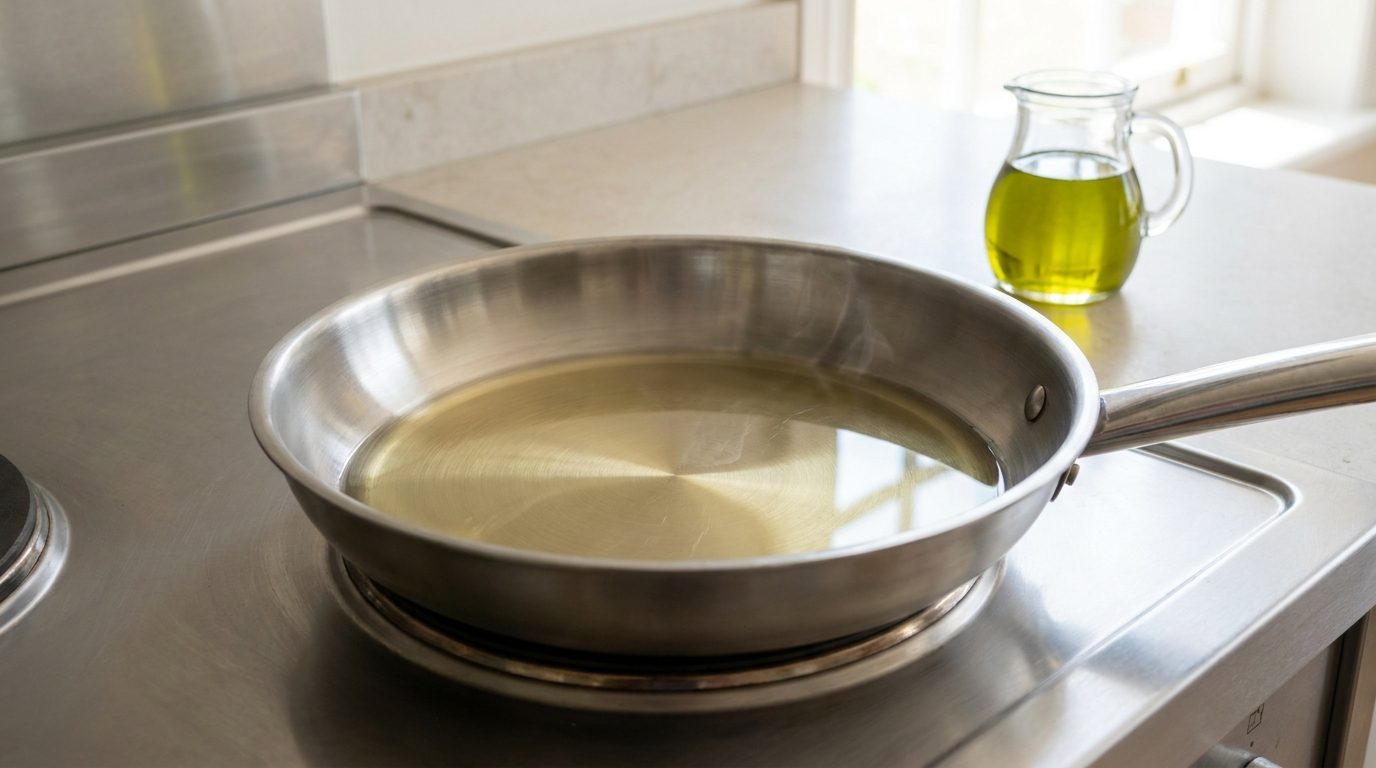
The most common objection to refined hemp oil is that processing must have destroyed the omega-3 that made hemp seed oil worth talking about. The fatty acids largely survive. Several other things do not, and those are the real basis for choosing between refined and cold-pressed.
Refining removes compounds, not fatty acids
Hemp seed oil's fatty acid profile is dominated by linoleic acid (omega-6) at roughly half the total, with alpha-linolenic acid (omega-3) commonly in the mid-teens to around twenty percent, a small and distinctive share of gamma-linolenic acid, and the balance made up of oleic, palmitic and stearic acids. That profile is a property of the triglycerides themselves — the bulk of the oil, not a trace fraction.
Degumming, neutralizing, bleaching and deodorizing all target the minor fraction: phospholipids, free fatty acids, pigments, waxes, odour compounds, trace metals. None of them is designed to convert one fatty acid into another or to selectively strip polyunsaturates. A refined and a virgin oil pressed from the same seed lot will show fatty acid profiles that look near-identical on a gas chromatograph, which is why supplier spec sheets for both grades quote broadly similar ranges.
So what does change?
| Component | Cold-pressed (virgin) | Refined |
|---|---|---|
| Linoleic and alpha-linolenic acid | Full complement | Essentially unchanged |
| Chlorophyll and carotenoids | High — the green colour | Largely removed |
| Tocopherols (vitamin E family) | Full complement | Substantially reduced |
| Phytosterols | Full complement | Reduced, largely retained |
| Free fatty acids | Variable, higher | Very low |
| Phospholipids and waxes | Present | Removed |
| Flavour and aroma | Grassy, nutty, assertive | Near-neutral |
Read down that table and the pattern is clear. What refining takes is the accompanying cast, not the lead.
The tocopherol trade-off
Tocopherols are the loss that matters most to anyone buying hemp oil as a food. They are volatile enough to distil off during deodorization, and the condensate collected from deodorizers is in fact a commercial source of natural vitamin E for other industries. Bleaching earth removes a further share by adsorption.
The counterintuitive result is that refined hemp oil is usually the more oxidatively stable product anyway. Tocopherols are protective, but chlorophyll, free fatty acids and trace copper and iron are aggressively pro-oxidant, and refining removes all three. Take away the accelerants and the oil lasts longer even with less of its own brake fluid. Many refiners then add tocopherols or rosemary extract back at the end, closing part of the gap deliberately.
Does refined oil still deliver nutritionally?
If your reason for buying hemp seed oil is its fatty acid ratio, refined oil delivers it. If your reason is the full spectrum of minor components — tocopherols, chlorophyll, the sterol fraction at its highest, the flavour that signals all of the above — then cold-pressed is the honest choice and refining works against you.
One caution applies to both grades. Alpha-linolenic acid is fragile regardless of how the oil was processed. Refined hemp oil tolerates more heat before it smokes, but a higher smoke point is not the same as heat-proof polyunsaturates. Sustained high-temperature cooking degrades the omega-3 in any hemp oil. The practical value of refining in the kitchen is that the oil does not smoke and taste burnt at moderate heat, not that the fatty acids become indestructible.
Trans isomers and deodorizer conditions
Deodorization runs hot, and polyunsaturated fatty acids can isomerize under prolonged heat, forming small quantities of trans isomers. This is a known consideration for every oil rich in linolenic acid, hemp included. In well-controlled refining the quantities are small, because operators deliberately keep temperature and residence time as low as the specification permits.
If this matters for your application or your label, it is a fair question to put to a supplier: what deodorization temperature and holding time do you run, and can you provide a trans fatty acid figure on the lot? A refiner who has thought about hemp specifically will have an answer. One who runs hemp on the same schedule as a robust tropical oil may not.
Choosing between them
Buy cold-pressed when the oil is the point: finishing oils, dressings, dips, and any product where a green colour and a nutty-grassy flavour are features you are selling. Buy refined when the oil is an ingredient that must not announce itself — baking and gentle cooking, soap and candle work, lotions and serums, hair products, lubricants and coatings — or when you need a long shelf life in a warm warehouse. Our other refined hemp oil guides go into the specific numbers for each of those uses.
A concrete way to settle it: buy a small bottle of each from the same supplier, taste them side by side, and then warm a spoonful of each gently in a pan. The difference in scent and colour will tell you more in five minutes than any specification comparison, and it costs the price of two small bottles.