
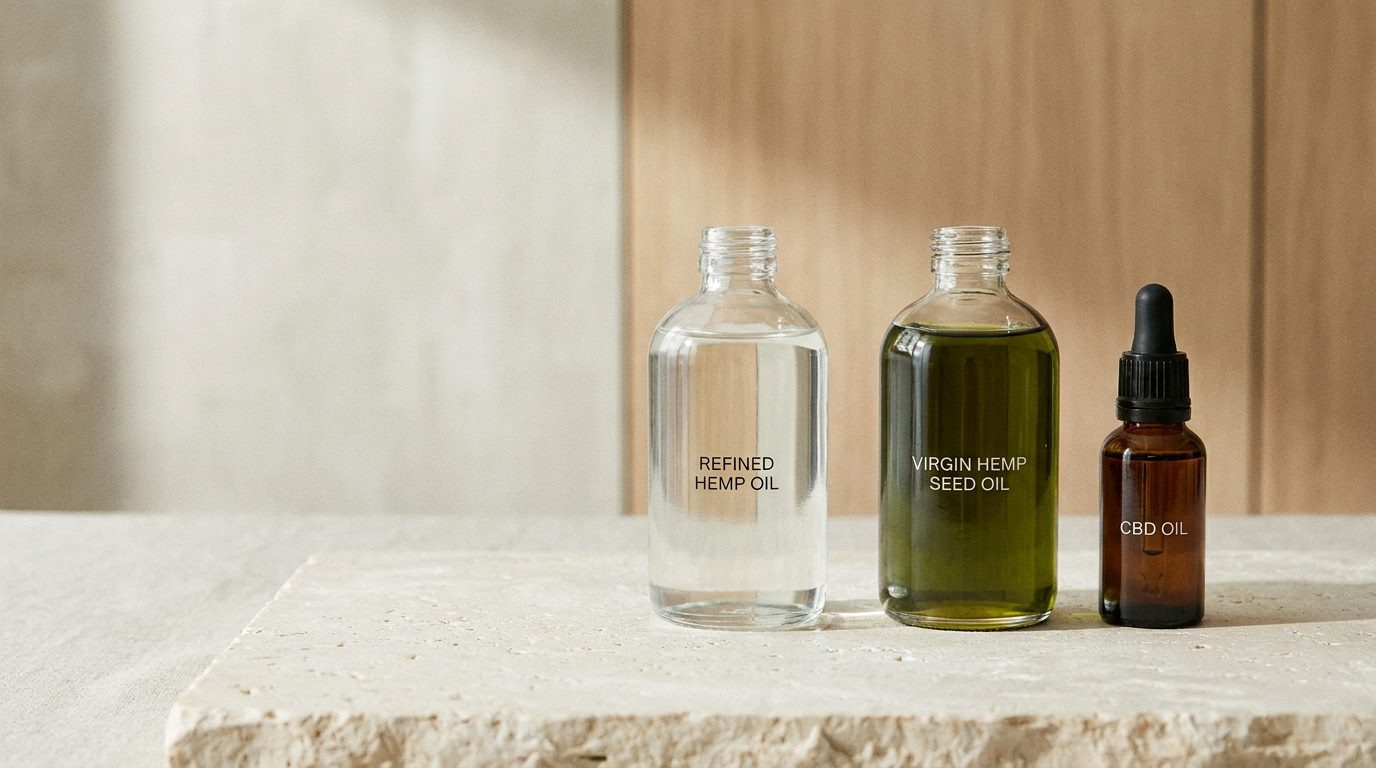
No, refined hemp oil is not the same as CBD oil. Refined hemp oil is pressed and processed from hemp seeds as a culinary and cosmetic oil, and it contains no meaningful amount of CBD or THC. CBD oil is a cannabinoid extract taken from the flowers and leaves of the plant. Three labels keep getting mixed up on store shelves, and the difference matters for what you are actually buying.
Why do people confuse these three products?
The confusion is built into the labels. "Hemp oil," "hemp seed oil," "hemp extract," and "CBD oil" all share the word hemp, all come from the same plant species (Cannabis sativa), and all sit near each other in stores and search results. Marketing has muddied the water further: some CBD products are labelled "hemp oil" to sidestep advertising restrictions, while some seed oils are labelled "hemp extract" to sound more potent than they are.
The reliable distinction is not the word hemp. It is which part of the plant the oil came from:
- Seeds contain fats but virtually no cannabinoids. Oil pressed from seeds is hemp seed oil, refined or virgin.
- Flowers and leaves contain the cannabinoids, including CBD and THC. Extract from these parts is what people mean by CBD oil.
Once you anchor on plant part rather than the marketing word, the three products separate cleanly.
What is refined hemp seed oil?
Refined hemp oil is cold-pressed hemp seed oil that has been through additional processing, typically degumming, neutralizing, bleaching, and deodorizing. The result is a clear, pale, flavour-neutral oil with a higher smoke point and longer shelf life than unrefined virgin hemp oil. It is a food and cosmetic ingredient, used for sautéing, baking, salad dressings, lotions, soaps, and carrier oils.
Because it is made from seeds, refined hemp oil carries the seed's nutritional profile, mainly polyunsaturated fats with a favourable omega-6 to omega-3 ratio, and contains no functionally relevant cannabinoids. Refining can strip away whatever trace cannabinoid residue clings to the seed hull during pressing, so refined hemp oil is, if anything, even further from being a CBD product than virgin hemp seed oil. Nothing about the refining step adds CBD; refining is about heat tolerance, colour, and flavour, not cannabinoid content.
What is CBD oil, and how is it different?
CBD oil is a concentrated extract of cannabidiol, one of the active compounds in the cannabis plant. It is drawn from the flowers, leaves, and other aerial parts where cannabinoids actually accumulate, usually through solvent or CO2 extraction, and then diluted into a carrier. That carrier is frequently a seed oil, which is exactly where the labelling confusion comes from: a bottle can legitimately list "hemp seed oil" as an ingredient while the active compound is CBD extract suspended in it.
CBD oil is sold and used for its cannabinoid content, with intended effects on the body. It is regulated differently from food oils in most jurisdictions, including in Canada, where cannabidiol products fall under cannabis and natural health product frameworks rather than being treated as grocery cooking oil. Refined hemp seed oil sold as a culinary product does not carry those claims and is not regulated as a cannabinoid product.
Will refined hemp oil show up on a drug test or get me high?
No. Two separate questions sit inside this one, and both answers point the same way.
Refined hemp oil will not get you high because it has no meaningful THC. THC is the intoxicating cannabinoid, and like CBD it lives in the flowers and leaves, not the seeds. A culinary seed oil simply does not contain a psychoactive dose.
On drug testing, the honest answer is that food-grade hemp seed oil is extremely unlikely to cause a problem, because the trace cannabinoid levels possible from seed processing are far below what a true CBD or cannabis product carries, and refining reduces them further. CBD oil is a different story: full-spectrum CBD extracts can contain small amounts of THC, and that is a genuine consideration for anyone subject to testing. This is precisely why the distinction is not academic. If you are buying a cooking or skincare oil, refined hemp seed oil keeps you well clear of the issue.
How can I tell which one I am buying?
The label tells you, if you know what to read. Use this quick comparison:
| Attribute | Refined hemp seed oil | Virgin hemp seed oil | CBD oil |
|---|---|---|---|
| Plant part | Seeds | Seeds | Flowers and leaves |
| Main purpose | Cooking, cosmetics | Dressings, finishing, skincare | Cannabinoid effect |
| CBD content | None meaningful | None meaningful | Concentrated |
| THC content | None meaningful | None meaningful | Trace to low (varies) |
| Sold by | Volume (mL/L) | Volume (mL/L) | CBD milligrams |
| Typical price | Lowest of the three | Mid | Highest by far |
Some practical tells:
- Check how it is sold. Seed oils are priced and sized by volume, such as 250 mL or 1 L. CBD oil is priced by cannabinoid milligrams, such as "1000 mg CBD." If you see a milligram strength front and centre, it is a cannabinoid product.
- Read the ingredient versus the active claim. "Hemp seed oil" as an ingredient is just the carrier. The presence of "cannabidiol," "CBD," "hemp extract," or "full/broad spectrum" signals a cannabinoid product.
- Look at where it is shelved and what it claims. A grocery cooking oil making no body-effect claims is seed oil. A wellness product promising effects is an extract.
- Mind the price gap. Refined hemp seed oil is one of the cheaper specialty oils per litre; CBD oil costs many times more for a small bottle. A large, inexpensive bottle is not CBD.
Which one do you actually need?
Match the product to the job rather than the name. If you want a neutral, heat-tolerant oil for sautéing, baking, or a manufacturing run, or a clean carrier oil for soap and skincare, refined hemp seed oil is the correct, affordable choice, and its lack of cannabinoids is a feature, not a shortfall. If you want the full flavour and antioxidant character of the raw seed for dressings or finishing, choose virgin cold-pressed hemp seed oil. Only if you are specifically seeking cannabidiol for its intended effects should you be looking at CBD oil, and at that point you should be reading milligram strengths, third-party lab certificates, and the THC figure, not the cooking-oil aisle.
The single most useful habit is to stop treating "hemp oil" as one thing. Ask which part of the plant it came from and how it is measured. Seeds and volume mean a food or cosmetic oil; flowers and milligrams mean a cannabinoid extract. For more on refined versus virgin hemp seed oil, smoke points, and where each oil performs best, browse our article index.
If you are actually looking for CBD rather than culinary hemp seed oil, the CBD guide at cbdhempoil.ca covers forms, labelling and buying safely in Canada.